If you haven't already done so stop by the Microsoft Convergence 2011 site at http://www.microsoft.com/dynamics/convergence/atlanta11/about_overview.aspx and sign up for Registration Alerts. You don't want to miss out on the early bird discounts.
See you in Atlanta!
09 November, 2010


04 November, 2010
Business Process Improvement with Conditional Process Holds in Dynamics GP Sales Order Processing
I was presented with a business process problem by a client related to managing Credit Limit overrides in Dynamics GP Sales Transaction Entry. This company does not supply Order Entry users with the Credit Limit override password. It's the Credit Manager's responsibility to decide whether or not to allow that override.
This client has been working for some time to generally route information to the right person that needs to make the decision and eliminate waste in their business processes. During the normal course of business when users are presented with the "Please enter the credit limit override password:" prompt the Credit Manager is called to the user's workstation to make the decision on the fly.

This is a very inefficient process. What a great opportunity for improvement!
To resolve this issue and get the information to the person responsible for making the decision while maintaining the system controls required we got creative with Process Holds, eConnect, and VBA with ADO. Here's what we did:
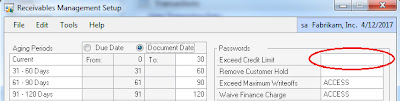
First, we removed the "Exceed Credit Limit" password from Receivables Management Setup:


This client has been working for some time to generally route information to the right person that needs to make the decision and eliminate waste in their business processes. During the normal course of business when users are presented with the "Please enter the credit limit override password:" prompt the Credit Manager is called to the user's workstation to make the decision on the fly.

To resolve this issue and get the information to the person responsible for making the decision while maintaining the system controls required we got creative with Process Holds, eConnect, and VBA with ADO. Here's what we did:
First, we removed the "Exceed Credit Limit" password from Receivables Management Setup:

Now, users would have been presented with the more friendly prompt that would allow them to proceed without a password.

I don't claim to be a SOX expert but I'm guessing that wouldn't pass a SOX audit. So, we added some VBA Code to the BeforeModalDialog Event behind the Sales Transaction Entry Window. Of course, to make this work you would need to add that window plus the DocumentNo and the SOPTypeDatabase fields to your project.

The code calls the taSopUpdateCreateProcessHold eConnect stored procedure and adds the "CREDIT" Process Hold to the Document when the credit limit prompt appears and closes the dialog box by answering Continue to the prompt automatically.

Now, instead of stopping the user in their tracks to make this decision on the fly the Credit Manager can manage this Process Hold separate from the Order Entry Process. To do this, we used SmartList Builder to build a SmartList that displayed SOP Documents On Hold. Then, we added a Favorite with a Reminder to the SmartList to show only SOP Documents with the "CREDIT" Process Hold applied.

Now, when the Credit Manager logs into GP and periodically throughout the day he can quickly and easily analyze the Sales Orders for Customers that had exceeded their Credit Limit and manage them accordingly.

Get the right information into the hands of the person who is responsible for making the decision and you too can improve your business processes and efficiency. It doesn't take much work or creativity to increase the ROI on your GP implementation using techniques such as this.
If you like this let me know. If enough people do, maybe we'll produce a new freebie for Dynamics GP!
Don't accept what you're given, make it into what you need it to be.
03 November, 2010
Dexterity isn't going anywhere... anytime soon.
The topic of whether to execute a project by developing in Dexterity came up in a requirements discussion I had this week after The Dynamics GP Blogster and then Mark Polino opined on the subject. I have spent some time thinking about this myself as we're also working on plans for 2011. I don't think Dexterity is going anywhere as long as GP is around although it will continue to get depreciated over time.
When Microsoft purchased GP and consolidated ERP solutions under the Dynamics brand all the buzz was about both consolidating those solutions into 1 best of breed solution and/or replacing Dexterity with (insert your favorite .Net language here). I don't even remember how long ago that was. We're not really any closer to realizing either vision even though it's clear that .Net is the future for GP.
With the introduction of the Visual Studio Toolkit we're able to finally do some GP Development work in Visual Studio. That's great but we still can't create Alternate Dynamics Windows or really modify existing GP windows in Visual Studio. Dexterity still provides the tightest integration. For some development projects, you just can't get around that. I can't really speculate on how reasonable it is to expect that to change anytime soon.
Mariano makes great points in his IMHO post that it is basically (my opinion, not his) just not reasonable to expect Dexterity to be replaced by .Net unless GP is abandoned as a viable ERP solution. The last I saw the Dynamics GP roadmap extended beyond v14 (2016). When it comes to selecting a development tool for GP it's inevitable that Dexterity will rise to the surface as the best tool for some projects. It's not always my first choice but sometime it is the best choice. I don't foresee that changing anytime soon.
There's a good white paper on choosing the right development tool for your Microsoft Dynamics GP 10 Development Project. http://www.microsoft.com/downloads/en/details.aspx?FamilyID=a5b6c523-0add-48fd-9deb-2c0ef39b5673
When Microsoft purchased GP and consolidated ERP solutions under the Dynamics brand all the buzz was about both consolidating those solutions into 1 best of breed solution and/or replacing Dexterity with (insert your favorite .Net language here). I don't even remember how long ago that was. We're not really any closer to realizing either vision even though it's clear that .Net is the future for GP.
With the introduction of the Visual Studio Toolkit we're able to finally do some GP Development work in Visual Studio. That's great but we still can't create Alternate Dynamics Windows or really modify existing GP windows in Visual Studio. Dexterity still provides the tightest integration. For some development projects, you just can't get around that. I can't really speculate on how reasonable it is to expect that to change anytime soon.
Mariano makes great points in his IMHO post that it is basically (my opinion, not his) just not reasonable to expect Dexterity to be replaced by .Net unless GP is abandoned as a viable ERP solution. The last I saw the Dynamics GP roadmap extended beyond v14 (2016). When it comes to selecting a development tool for GP it's inevitable that Dexterity will rise to the surface as the best tool for some projects. It's not always my first choice but sometime it is the best choice. I don't foresee that changing anytime soon.
There's a good white paper on choosing the right development tool for your Microsoft Dynamics GP 10 Development Project. http://www.microsoft.com/downloads/en/details.aspx?FamilyID=a5b6c523-0add-48fd-9deb-2c0ef39b5673
02 November, 2010
Decisions 2010 - Extending Your GP Distribution Solution with the Field Service Series Session Materials Available for Download
I have posted both a .pdf version and a .ppsx version of the Decisions 2010 - Extending Your GP Distribution Solution with the Field Service Series presentation for download.
The Emerging Partner in the Microsoft Dynamics Partner Channel
NavigateIntoSuccess.com has a nice write up on the direction Microsoft is taking with small Dynamics partners based some insight from a blog post by Alex Chow. http://navigateintosuccess.com/blog/is-microsoft-killing-the-small-partners.
It is a tough environment and getting tougher for some but I agree with Vjekoslav that they're not trying to kill us off. I say "us" because my company could be considered a "small" partner but we don't fall into any of the 3 categories of small partners that Alex describes in his post:
1. Small newcomers that oversell and don't execute.
2. Internal companies that arbitrage the partner program to get free licensing.
3. Lifestyle partners that don't sell and therefore don't send any revenue Microsoft's way.
There's another category he didn't account for; 4. Emerging Partners - broadly experienced partners that are growing organically at their own pace.
There are many Emerging Partners in the channel that are focused on profitable growth at a pace that is manageable for their business. Often, Emerging Partners are a better fit for even the larger Dynamics customers. They specialize more and don't try to be everything to everyone which is a plus for customers that typically don't implement more than one ERP system anyway.
So, what is it that Dynamics customers are looking for in a Partner? A few of the primary characteristics of a good partner include:
1. A conscientious business partner that delivers value in excess of its cost with the highest level of integrity and professionalism.
2. Timely access to expert product consultants that can deliver the technology solutions and services required as well as other services the customer may not have anticipated needing.
3. Proactive communication through e-mail, phone calls, newsletters, webinars, blogs, etc. to deliver the latest Microsoft Promotions, Tips and Tricks, and Product Releases.
Emerging Partners engage on projects on which they know they can be highly successful and employ senior level consultants and developers. They are establishing themselves in the channel through superior delivery of services not another metric that does not benefit the customer such as top line software licensing revenue that drives margins for the partner. Margins take a backseat to customer satisfaction but overhead is lower for them. They won't win worldwide partner of the year but that's not their goal.
With a core team of the right people with the right mix of skills and experience an Emerging Partner can deliver the Microsoft Business Solutions stack extremely effectively; Dynamics ERP/CRM, SharePoint, SSRS/Business Intelligence, and Custom .Net solutions and services. Sure, there are projects on which more and/or other resources are required but Emerging Partners have their own networks of experienced professionals to fill those gaps when needed. The larger partners all face the same challenges as they push their own consultants to triple digit utilization while managing a healthy sales pipeline.
Emerging Partners have fewer full-time sales people which can be a benefit to the customer. They typically engage senior level consulting resources, project managers, or firm owners as account managers who can address customer needs directly; engaging sales resources when necessary. They maintain a more intimate relationship with their customer base. They often turn down opportunities to engage with new customers if those engagements/customers aren't a good fit with their strategy; 100% customer satisfaction and retention.
Emerging Partners can afford to grow more slowly, be selective on the work that they do, and focus on customers first and prospects second. There's a lot of value in that strategy for those customers that are lucky enough to work with an Emerging Partner.
It is a tough environment and getting tougher for some but I agree with Vjekoslav that they're not trying to kill us off. I say "us" because my company could be considered a "small" partner but we don't fall into any of the 3 categories of small partners that Alex describes in his post:
1. Small newcomers that oversell and don't execute.
2. Internal companies that arbitrage the partner program to get free licensing.
3. Lifestyle partners that don't sell and therefore don't send any revenue Microsoft's way.
There's another category he didn't account for; 4. Emerging Partners - broadly experienced partners that are growing organically at their own pace.
There are many Emerging Partners in the channel that are focused on profitable growth at a pace that is manageable for their business. Often, Emerging Partners are a better fit for even the larger Dynamics customers. They specialize more and don't try to be everything to everyone which is a plus for customers that typically don't implement more than one ERP system anyway.
So, what is it that Dynamics customers are looking for in a Partner? A few of the primary characteristics of a good partner include:
1. A conscientious business partner that delivers value in excess of its cost with the highest level of integrity and professionalism.
2. Timely access to expert product consultants that can deliver the technology solutions and services required as well as other services the customer may not have anticipated needing.
3. Proactive communication through e-mail, phone calls, newsletters, webinars, blogs, etc. to deliver the latest Microsoft Promotions, Tips and Tricks, and Product Releases.
Emerging Partners engage on projects on which they know they can be highly successful and employ senior level consultants and developers. They are establishing themselves in the channel through superior delivery of services not another metric that does not benefit the customer such as top line software licensing revenue that drives margins for the partner. Margins take a backseat to customer satisfaction but overhead is lower for them. They won't win worldwide partner of the year but that's not their goal.
With a core team of the right people with the right mix of skills and experience an Emerging Partner can deliver the Microsoft Business Solutions stack extremely effectively; Dynamics ERP/CRM, SharePoint, SSRS/Business Intelligence, and Custom .Net solutions and services. Sure, there are projects on which more and/or other resources are required but Emerging Partners have their own networks of experienced professionals to fill those gaps when needed. The larger partners all face the same challenges as they push their own consultants to triple digit utilization while managing a healthy sales pipeline.
Emerging Partners have fewer full-time sales people which can be a benefit to the customer. They typically engage senior level consulting resources, project managers, or firm owners as account managers who can address customer needs directly; engaging sales resources when necessary. They maintain a more intimate relationship with their customer base. They often turn down opportunities to engage with new customers if those engagements/customers aren't a good fit with their strategy; 100% customer satisfaction and retention.
Emerging Partners can afford to grow more slowly, be selective on the work that they do, and focus on customers first and prospects second. There's a lot of value in that strategy for those customers that are lucky enough to work with an Emerging Partner.
Subscribe to:
Posts (Atom)